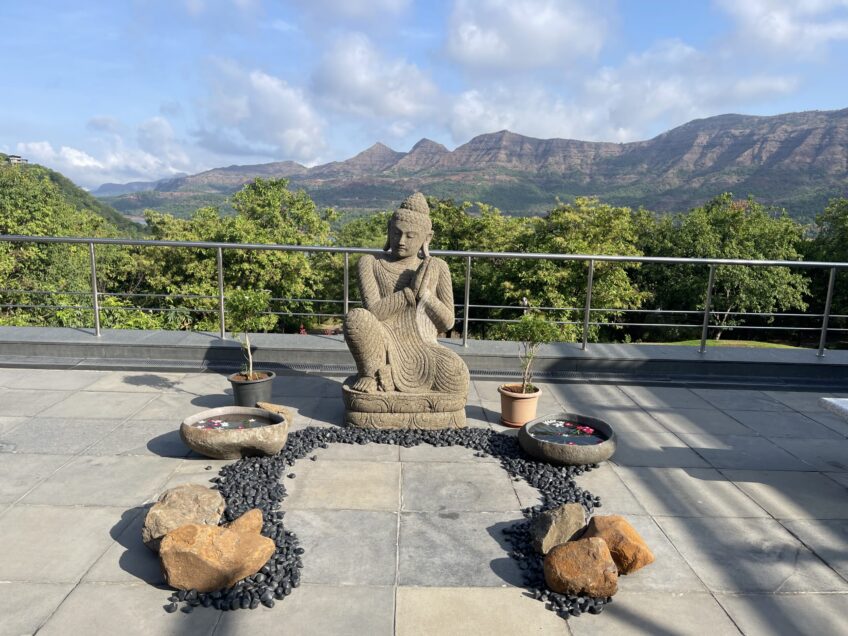
A few weeks ago, I spent seven days at a wellness retreat in the Sahyadris.
There were doctors, therapists, yoga sessions, meditation halls, organic farms, barefoot walks, and enough healthy food to make a lifelong ginger chai enthusiast voluntarily stop drinking tea for eight days.
Yet the most important lesson had very little to do with wellness.
It began with an uncomfortable observation.
Most of us are constantly improving something.
We improve our careers. Our homes. Our teams. Our businesses. Our productivity systems. Our children’s futures.
Improvement has become a way of life.
And yet, somewhere in the middle of all this progress, we quietly stop improving the one person experiencing it all.
Ourselves.
Not our resumes. Not our skills. Not our balance sheets.
Us. The human being beneath the professional identity. The person beneath the title. The soul beneath the schedule.
During the retreat, the days followed a simple rhythm.
Wake early. Walk. Breathe. Eat mindfully. Move. Rest. Sleep.
Nothing revolutionary. Nothing expensive. Nothing particularly difficult.
And yet, by the fourth day, something surprising happened.
The body began to cooperate. The mind became quieter. The constant internal urgency softened.
I realised how much of modern life is lived slightly out of rhythm.
We sleep later than our bodies prefer. We eat faster than our digestion appreciates. We consume more information than our minds can process. We spend more time connected than we do present.
And then we wonder why we feel tired.
There was another realisation that stayed with me.
Many of the practices that produced the biggest shifts were astonishingly simple.
Morning sunlight. Walking barefoot on the earth. Eating earlier. Breathing more consciously. Sleeping on time. Spending less time with screens.
None of these would qualify as innovation. Most would not attract venture capital.
Yet they worked.
Perhaps one of the great mistakes of modern life is assuming that every meaningful solution must be complex. We have become brilliant at building sophisticated external systems. The body, however, still runs on ancient code.
It responds to rhythm. To light. To movement. To rest. To attention.
The body is not asking for heroics. It is asking for cooperation.
Three ideas emerged from that week. They have not left me since.
Rhythm over resolution. True alignment is not aggressive discipline — it is a design philosophy. Sleeping at 10 and rising at 5 is a complete sentence. The body already knows its optimal baseline. Our only job is to stop arguing with it. Consistency does not demand heroics. It simply builds the biological scaffolding that everything else hangs from.
Food as mindful medicine. We routinely surrender our physical fuel to processed shortcuts. Simple, whole ingredients, eaten at the right hour, possess an immediate pharmacological power that most of us have never tested because we have never truly tried. Transformation does not require deprivation. It requires structural intelligence. The most surprising lesson of the week was not what I ate. It was what I stopped consuming. Tea. Sugar. Noise. Urgency.
Restoring the holy trinity. As a culture, we are masterful at sharpening the intellect. More recently, we have begun paying attention to the body. But the soul — that quiet, luminous inner dimension — is often treated as a background process, served last, if at all. No popular metric tracks it. No dashboard measures it. No wearable device can tell us when it is thriving. Yet its neglect is quietly felt everywhere. True equilibrium requires treating mind, body, and soul not as separate silos but as one deeply interconnected ecosystem.
The great paradox of modern life may be this.
We have never been better at transforming everything around us.
And we have never found it harder to transform what is within us.
Progress has given us many gifts. But it has also created a peculiar illusion: that transformation is something external. A better role. A better city. A better device. A better future.
Yet some of the most meaningful transformations begin when nothing external changes at all.
When we sleep a little earlier. When we pay attention to what we eat. When we sit quietly for ten minutes. When we take a walk without headphones. When we listen — not to the world, but to ourselves.
And perhaps that is why this feels increasingly important in the age of AI.
As machines become better at processing information, generating content, and automating work, the distinctly human dimensions of life become more valuable, not less.
Presence. Awareness. Stillness. Meaning. Compassion. Connection.
No machine can meditate on your behalf. No algorithm can walk barefoot on the earth for you. No agent can cultivate your inner life.
The future may belong to intelligent machines.
But fulfilment will still belong to conscious humans.
We spend our lives transforming businesses, technologies, and futures.
We are becoming masterful at it.
The internal equivalent — the upgrade that runs underneath everything else — gets scheduled for later. For when things slow down. For the next quarter. For the version of ourselves that never quite arrives because the calendar never clears itself on its own.
The most important transformation is still the one within.
Not escape. Not indulgence. The possibility of becoming more alive.
A question for reflection
What part of your life have you been diligently improving while quietly neglecting yourself?
And what might change if you gave the same attention to your inner life that you give to your ambitions?
Soulware is a space for reflection on the inner life — beyond busyness, beyond achievement, beyond the horizon.
#Soulware #TheMostImportantTransformation #MindBodySoul #IntentionalLiving #Sunshine #Leadership #Mindfulness #Alive


Leave a Reply