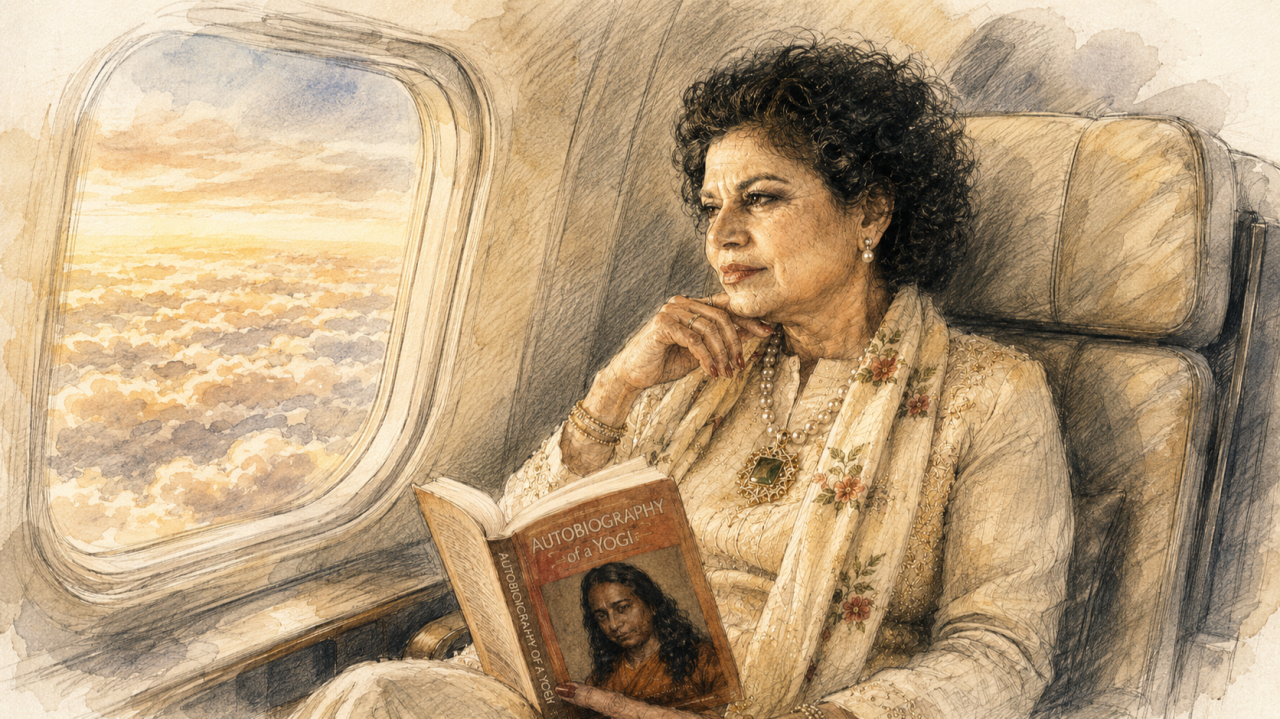
The cabin was empty. She was the only passenger in the first-class compartment, somewhere between the closing dinner and the next morning’s press release. The deal in her briefcase would, when she signed it on Monday, take her firm into a different weight class — a mega institution, the kind of client she had spent a decade learning how to win. The plane was returning her, with the press release already drafted, to a city where her husband and her young daughter were asleep.
And then, somewhere between the meal service and the descent, she began to cry.
She tells the story carefully when she tells it now, because she needs you to understand one thing about her: she did not cry. Not as a partner at McKinsey. Not as the young woman who had walked down Park Avenue at midnight in a sari, with two suitcases and no hotel room. People who know me will tell you I’m just not a crier. Even when I was little, I wouldn’t cry.
She did not know why she was crying. It was not sorrow. It was not regret. The book in her hands was Autobiography of a Yogi. The deal was not a bad deal. The career was not a wrong career. And yet the tears kept coming, all the way to the descent.
On Monday morning, she called the client. She told them she could not sign. The press release would have to be killed. The deal — by then nearly two years of work — would have to be handed back. They told her she was crazy. She knew she was not.
The decision cost her a great deal. It took her months to undo what the next twenty-four hours of her life were supposed to do. But the question that had arrived uninvited in the first-class cabin, without sorrow and without reason, did not leave her. It only got larger.
I will make more money. I will have more fame. And when does it stop. What is enough.
I watched the WIMWIAN Trailblazers podcast featuring Chandrika Tandon . The conversation was recorded at Indian Institute of Management Ahmedabad — she was back for her fiftieth reunion, the first guest of a new podcast the endowment fund had built to listen to its own.
And the moment I keep returning to is not the Grammy. It is not the hunger strike at seventeen. It is the cabin. The tears of a woman who did not cry. Because what arrived on that flight was not a midlife crisis. It was a question. And the question is the same one that, at a certain hour in a certain decade of a certain kind of life, arrives uninvited at the door of every serious person.
To understand the question, you have to understand what was sitting in the briefcase on the seat beside her.
She had reached, by then, a place few advisers reach in any market in any decade. Her firm — which she had started by liquidating her own retirement savings, by bleeding money for eleven months without a single client, by signing paid-on-success contracts because she was that certain of her formula — had become a discreet engine of restructuring at the centre of American banking. She had taken a bank whose stock traded at a dollar and five-eighths and walked it, in four years, to sixty-one dollars a share. She had done it again, and again. She was, at one point in her career, a disclosable event for the SEC: when a bank hired her, they had to file. The stock would move on the news of her name. People called her office at odd hours just to learn which town she was flying to, so they could guess which bank might be next.
The deal in the briefcase was the next size up. It would have moved her firm from the company of advisers into the company of the institutions they advised. It was, in every external sense, the deal of a career.
She did not sign it.
What she did instead, in the months and years that followed, was strange in the way that intentional lives are always strange to those still living accidentally.
She began, at the same age at which her contemporaries were preparing to slow down, to learn music seriously. She had sung all her life — when I hear an air conditioner, I am making a tune; when I hear the sound of thunder, I am making a tune — but always around the edges of the work. Now she wanted the masters. The masters do not take pupils in middle age; they take them at four. So she became, in her own phrase, a music beggar. She found a Carnatic teacher at Wesleyan University, two hours from her Manhattan apartment, and she asked him for a 6 a.m. Saturday class because it was the only window her life left her. He kept refusing. She kept asking. He finally agreed.
For a year and a half, every Saturday, she set her alarm for half past three. She walked out of her building. She de-iced her car — sometimes for an hour, at two thirty in the morning, because the car was parked on the street. She drove the two hours with the cassette playing the scales she would be tested on. She sat in his living room from six to eight. She drove the two hours back. She bought a muffin on the way. She was home by quarter past ten, in time to wake her daughter.
She was at the time still running her firm.
The music was the first of the journeys. The giving was the second.
She did not begin with a cheque. She walked into NYU one afternoon — it was the closest serious institution to her apartment — and she asked the dean whether she might be useful. Can I please give myself. She offered a few hours a week as a mentor. They asked her to be the Distinguished Executive in Residence at the Stern School. Three hours a week became three days a week. She taught classes. She sat in on faculty lunches and interrogated the professors about their research. Several years in, the president of NYU invited her to join the board. From the board of NYU she became chair of the engineering school, which has since taken her family name. The Tandon School of Engineering at NYU. The Boyd Tandon School of Business at Madras Christian College. The Krishnamurthy Tandon School of Artificial Intelligence at IIMA Ahmedabad — the institution that is now hosting the conversation in which she is telling the story.
She has a rule for any of it. Time, talent, and treasure must align. If she cannot give all three — if she cannot get inside the project, learn it, walk it into being — she does not write the cheque. The cheque is the lightest of the three. The hardest is the time. Anyone can give what is in their account. Few can give what is on their calendar.
She has a phrase for the kind of work this becomes, and it is, I think, the most beautiful phrase in the conversation. We have a lot to learn from people who planted these banyan trees we are all sitting in the shade of. The image is older than her. It is older than any of us. But the people who actually plant banyans in their lifetime are rare, because banyans do not grow in your lifetime. They grow in someone else’s. To plant a banyan is to give shade to a child you will never meet.
But the question has not yet arrived.
The question arrives when she is asked, late in the conversation, about the world her grandchildren will work in. Her register changes — no longer the register of a woman remembering, but of a woman watching. She has just met, she says, a senior executive in the United States who is now running a company with annual revenues of a hundred million dollars and a single employee. He had been running it before, she says, with seventy-eight. She wonders aloud what becomes of the seventy-seven. She says, almost in passing, that the speed of all of this means we will be in continuous beta mode for the rest of our working lives.
Then she says the line that, when I heard it the third time, I went back to the transcript and underlined.
Machines can do everything faster. Machines have got domain knowledge. We have to figure out how to be wholly human.
Becoming wholly human, she says, is becoming more centred. One cannot have a moral compass if one is stressed out inside. One cannot, she says, be a boat that carries others across the water if one’s own boat is full of holes.
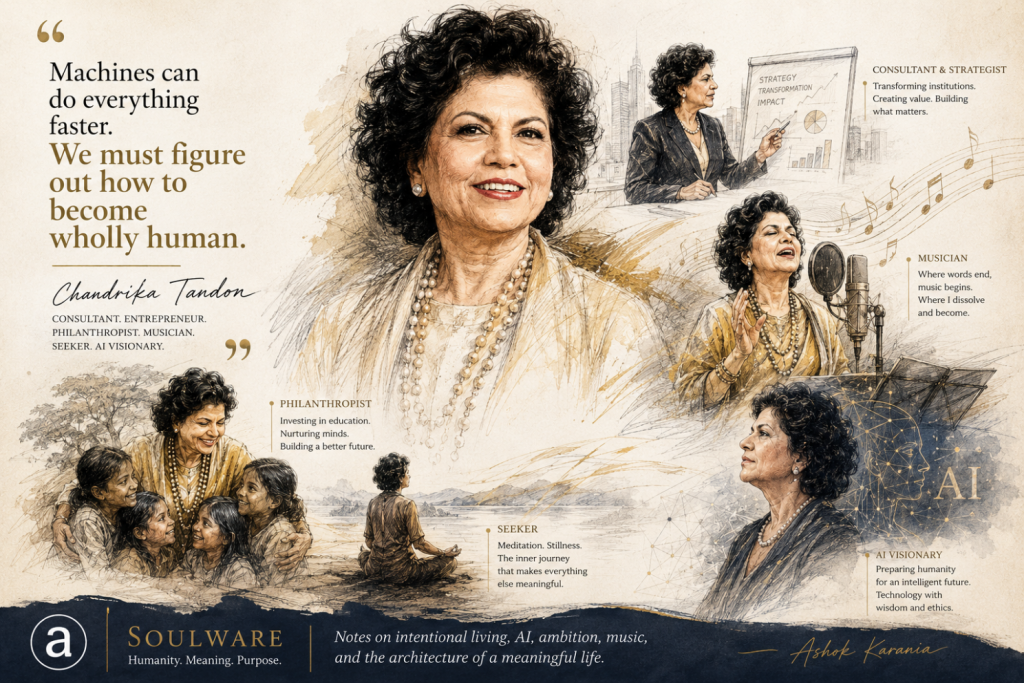
Years after the flight, in a podcast taping at IIMA Ahmedabad, she would say something else — quietly, almost in passing.
If I died right now, I would have zero regrets.
It was, in its own way, the answer to the question that had arrived uninvited in the cabin.
The cabin, then, was not a turning point. It was a hearing. The question had been in the air for some time. The first-class compartment, with its empty seats and its single passenger and its Yogananda paperback, was simply the room quiet enough for her to hear it.
Most of us will not get a cabin. Most of us will get a Tuesday morning. And the question, when it arrives — and it arrives, eventually, for anyone whose life is built on momentum — does not announce itself. It does not come dressed as crisis. It comes, sometimes, as tears with no obvious cause. It comes, more often, as the slow realisation that the calendar one is keeping is not the life one is living.
Her answer turned out to be specific, idiosyncratic, a little inconvenient. Music at six on Saturday mornings. A board seat at NYU. A banyan-shaped school at the institution she had once been afraid to leave Chennai for. The shape of her answer is not the shape of yours. The shape of your answer is your own.
But the question is the same. It is the only question that survives the climb.
When does it stop. What is enough.
This essay is a reflection on a conversation recorded for WIMWIan Trailblazers, the inaugural podcast series of the IIMA Endowment Fund, with Chandrika Tandon (PGP 1975) as its first guest. The full episode is available below.
🎙️ Watch on YouTube: https://lnkd.in/gTizgv3Q
🎧 Listen on Spotify: https://shorturl.at/KV9ua
With gratitude to the IIMA Endowment Fund team for bringing this conversation into the world.
#Soulware #SunshineLife #WhatIsEnough #IntentionalLiving #ChandrikaTandon #IIMA #Leadership