Nineteen years helping carry a living language into the digital century — because one eighty-four-year-old man with a Remington typewriter and thirty years of stubbornness refused to let Gujarati fade quietly from the world.
One of the most special chapters of my life!
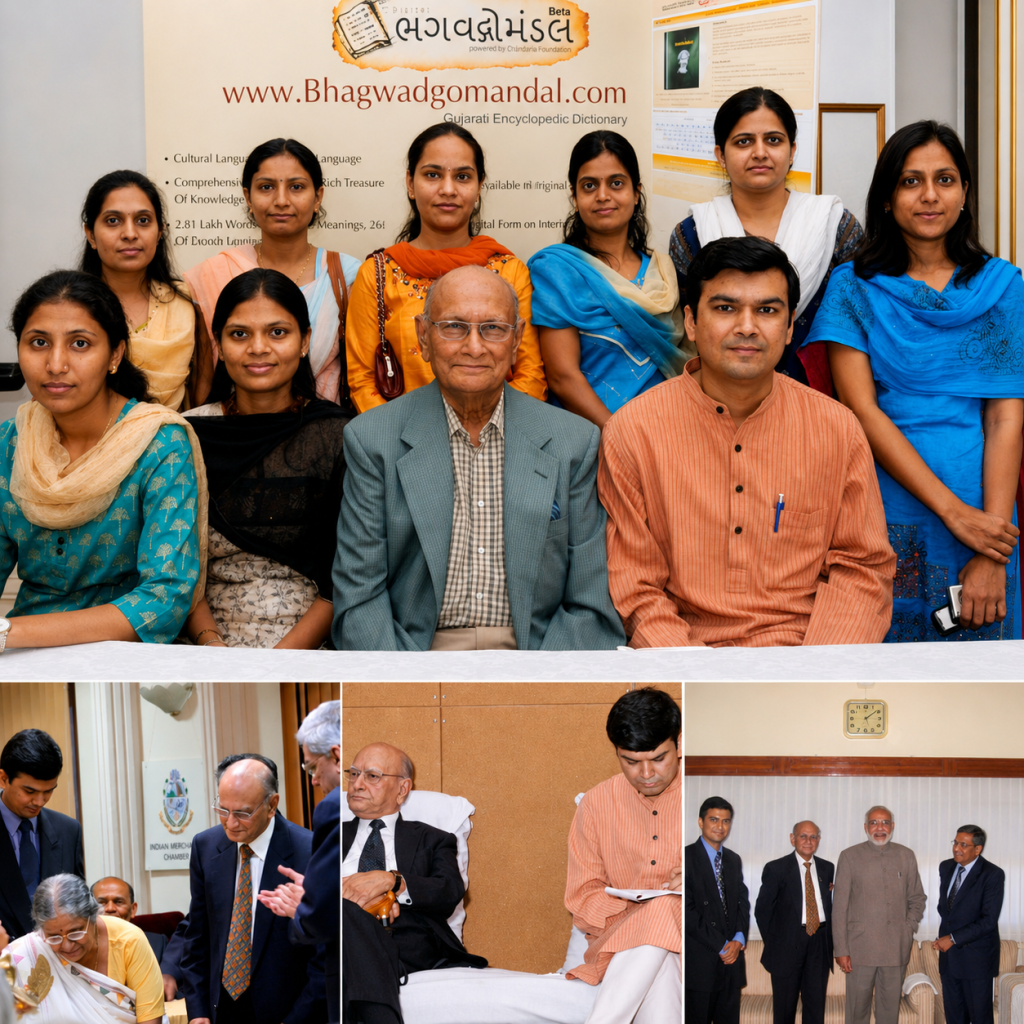
Snapshot
- Spearheaded by Shri Ratilal P. Chandaria (Rati Kaka), begun in 1975; GujaratiLexicon launched 13 January 2006
- 45 lakh+ words across all dictionaries — the world’s largest online Gujarati language resource
- Digital Bhagwadgomandal — 9,200 pages, 2.81 lakh words, digitised in eleven months by a team of fifteen
- Catalogued by the United States Library of Congress and the British Library
- Oxford University Press partner since 2017 — the Gujarati Living Dictionary, part of Oxford Global Languages
- Lok Kosh — the people’s dictionary that brought feku and selfie into formal Gujarati vocabulary
- C-DAC partnership; integrations with Mozilla Firefox, OpenOffice, Drupal; mobile apps on iOS, Android, BlackBerry, Windows Phone
- All-women technical team from 2009 onwards, through Arnion Technologies
- 4 crore+ cumulative visits by 2020; launched at the hands of then Chief Minister Narendra Modi and Gujarati literary legend Dhirubahen Patel
The Journey
You must remember that for a man like you to live in itself is a service to your country, for your life is not merely useful, but it is a light to others. — Rabindranath Tagore to G. K. Gokhale, December 1913 (The line I quoted in my homage to Rati Kaka, Ahmedabad, 21 October 2013)
In early 2005, I received a phone call on behalf of a man I had not yet met. His name was Ratilal P. Chandaria. He had heard about Utkarsh — the Gujarati operating system we had been building inside Magnet Technologies. He was about to fly to London. He wanted, before he left, to see what we were doing in Gujarati. He was persistent. I obliged. Because he was from my Halari community
He came to our humble office in Borivali on a punishing afternoon, after two hours through the city’s traffic. He was eighty-four. He could not hear well; a younger colleague sat beside him, repeating our answers into his ear. He asked many questions. Some not so comfortable. He said very little about himself.
I went home that evening, searched his name, and was wonderfully surprised. I had met, that afternoon, a man in his eighties with the curiosity of a student, the energy of an entrepreneur, and the devotion of a missionary. What he had done — alone, across thirty years, for the love of a language — was something universities or governments ought to have been doing. He had begun in 1975, with a Remington typewriter bought in Nairobi in 1946 and self-taught. He had chased fonts and keyboards and software across the United States, the United Kingdom, Canada, Germany, India. Met Microsoft, Apple, IBM, Tata — anyone who would listen. Spent two decades, his own money, his own days, his own diminishing strength.
He had postponed his flight to London once he heard about us.
That meeting was the beginning of nineteen years of my working life.
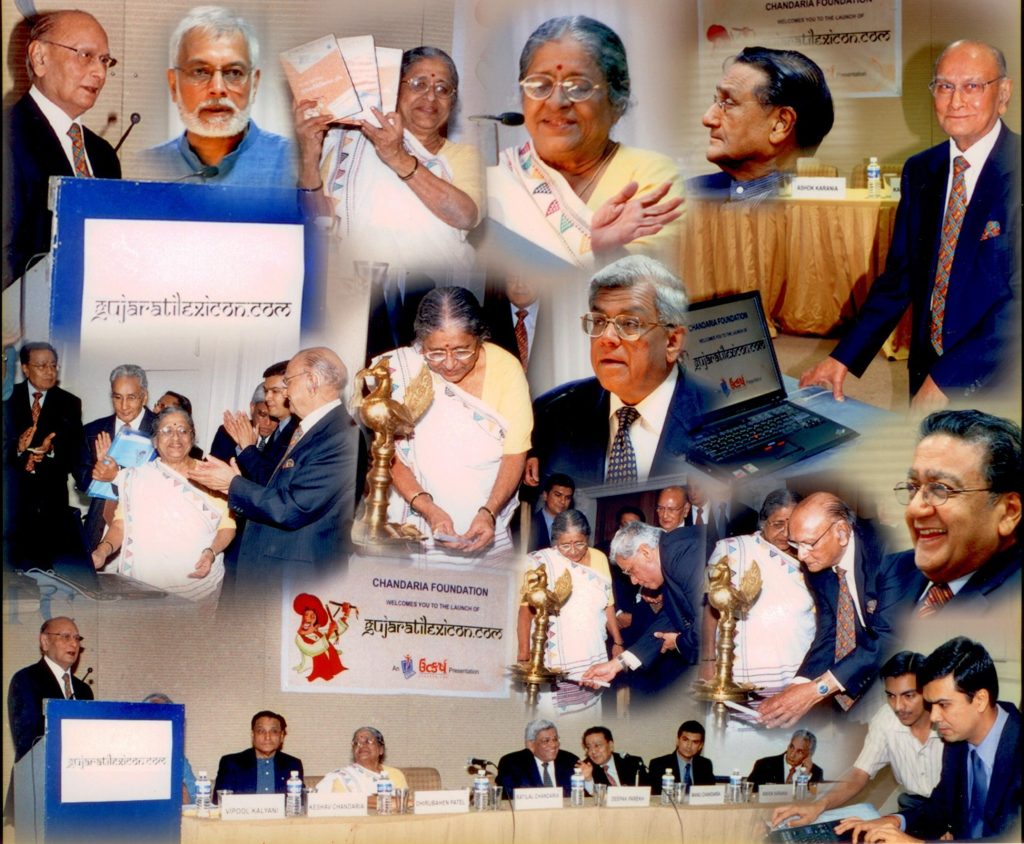
The launch — 13 January 2006
GujaratiLexicon went live with the blessings of the great Shri K. K. Shastri — the last grand man of Gujarati lexicography — and the then Chief Minister of Gujarat, Shri Narendra Modi. The grand dame of Gujarati literature, Sushri Dhirubahen Patel, dedicated the project to the world.
Ratikaka could have launched at the hands of anyone. Mr Deepak Parekh of HDFC was at the event. Dr Viren Shah, Governor of Bengal, was there. But Ratikaka had decided long before, in private, that the project would be launched only by Dhirubahen, who had stood by him through the years when no one else believed. The Modi invitation became a prelude. The launch itself was Dhirubahen’s morning. That was who he was.
The first lakh visitors arrived within weeks. The first ten lakh within months. What surprised us most were not the numbers — it was the letters. NRIs from Toronto writing that their children were finally engaging with their grandfather’s tongue. Schoolteachers from rural Saurashtra reporting that students were using the dictionary to look up words their textbooks could not explain. Eighty-year-olds Ratikaka had imagined as the core audience, and eight-year-olds who became its biggest fans through the games and quizzes.
GujaratiLexicon was, against every business plan, a small national event.
Digital Bhagwadgomandal — Mahavir Jayanti, 18 April 2008
If GujaratiLexicon was the work of a decade, the Bhagwadgomandal digitisation was the work of one year that proved we could do harder things.
Bhagwadgomandal is the largest and most prolific encyclopaedic work in the Gujarati language — nine volumes, 9,200 pages, 2.81 lakh words, 8.22 lakh meanings, compiled over twenty-six years by the visionary Maharaja Bhagwatsinhji of Gondal. When it was reprinted in 1986, Ratikaka had bought several sets at once and decided, the day those sets arrived, that he would see it digitised in his lifetime.
We started on Mahavir Jayanti 2008. A team of fifteen, working in parallel across three locations, in what we called mission-mode speed. We finished in eleven months. Ratikaka, eighty-seven by then, drove personally to Gondal to discuss the project details and legalities with the Gondal Municipal Corporation.
In 2010, the digital Bhagwadgomandal was selected by the United States Library of Congress for its catalogue of significant Gujarati reference works. The British Library followed. A small team in Ahmedabad had produced a work that two of the great national libraries on opposite sides of the world considered worth preserving permanently. Within months of launch, it had more readers than the printed nine volumes had reached in five decades
Ratikaka had been right. The dream had been worth twenty-six years of Bhagwatsinhji’s life and three of ours.
Lok Kosh — October 2009
GujaratiLexicon was, by then, a standard dictionary — approved, anchored in the Sarth tradition, careful with words. But Gujarati on the streets of Ahmedabad, in the bazaars of Surat, was running far ahead of any dictionary. The Sarth Kosh had been last updated in 1967.
So in October 2009, we launched Lok Kosh — a dictionary of the people, by the people, for the people. Users submitted new words. Others voted. Words that earned popular legitimacy entered the lexicon. In one early year, Lok Kosh added 920 words to the recorded Gujarati language. By 2015, the Times of India was reporting that feku and selfie had both entered Gujarati through Lok Kosh.
Language is a flowing river. We had built it a small new bank.
It has been since leveraged for updating all Gujarati dictionaries including Sarth.
The wider digital library — Sarth, Vishwamanav, Gandhi, and more
Beyond the headline projects, GujaratiLexicon quietly became the engine for a wider body of Gujarati digital heritage work across the years.
The Sarth Kosh — Gujarat Vidyapith’s standard Gujarati dictionary, the authoritative reference of the language — was digitised and brought into the GujaratiLexicon platform, making the work of generations of Gujarati scholars searchable and accessible for the first time in the digital age. The Vishwamanav project extended the platform’s reach into the broader humanist tradition of Gujarati thought. And in one of the quieter honours of the entire nineteen years, GujaratiLexicon helped Dina Patel preserve and present the Collected Works of Mahatma Gandhi in Gujarati — a hundred volumes of Gandhi’s own words, written and spoken across a lifetime, entrusted to a team in Ahmedabad that understood both the language and the responsibility.
The GL Crossword brought the language into play — monthly puzzles that became a quiet ritual for Gujarati readers across the world, making vocabulary a game rather than a lesson. eChaapu extended the platform’s reach into digital typography, helping publishers and designers work in Gujarati with tools that met professional standards. And the C-DAC partnership — with the Government of India’s premier computing research institute — was given its highest public moment when the Gujarati Software Tools and Fonts were launched with the blessings of Prime Minister Manmohan Singh and Congress President Sonia Gandhi, placing GujaratiLexicon’s work at the highest table of India’s national language technology programme.
Each of these was its own small adventure. Together, they made GujaratiLexicon not merely a dictionary, but a platform — the central digital address of the Gujarati language.
Oxford — August 2017
The milestone I am quietly proudest of came in August 2017, when Oxford University Press invited GujaratiLexicon to partner on the Gujarati Living Dictionary, as part of the Oxford Global Languages initiative.
For a small team in Ahmedabad to be invited by Oxford to co-build a Gujarati dictionary was not a thing any of us, in 2005, had foreseen would be possible. What had begun as one industrialist’s Remington typewriter ambition in 1946 had, seventy-one years later, become a partnership with the University of Oxford.
The all-women team
In 2009 — earlier than most technology projects in India, and earlier than almost any in Gujarat — GujaratiLexicon became an entirely women-led technical team, through Arnion Technologies. Editors, linguists, developers, content curators, project managers. By 2012, the entire active team was women.
A senior Gujarati journalist once walked in for an interview, looked around, and waited for the men in charge to come out of a meeting. There were no men in charge. There were no men. There was a team of remarkable people doing the most ambitious Gujarati language work the language had ever seen.
Ratikaka and I were mighty proud as avowed feminists. I consider this the quietest accomplishment of the project, and the one I am most personally grateful for. The Gujarati language is, depending on which century you ask, either a mother tongue or a mother work. Watching it carried into the digital century by a team of women felt like its own quiet poetry.
The people who were GujaratiLexicon
A project of nineteen years is only possible because of the people who carry it — and GujaratiLexicon was carried by remarkable ones.
Shri Vipool Kalyani — mentor, friend, and one of Gujarati world’s most quietly influential cultural figures — was among the first to believe in the project and among the most consistent in his support across the years. He opened doors, offered counsel, and embodied the kind of Gujarati public intellectual who understood that language preservation was not a nostalgic exercise but an act of civilisational responsibility.
The GL Advisory Board and Trustees — Shri Uttam Gajjar, Shri Balvant Patel, Shri Mansukh Shah, and Shri Vipool Kalyani — nurtured the movement with the same love and passion as Ratikaka himself. Sushri Dhirubahen Patel was the guiding light across the entire journey, from the pre-launch years through the Oxford collaboration. The scholarly panel she had assembled — Vinod Adhvaryu, Kulinchandra Yagnik, Rasendra Pandya, Babulal M. Shah, Chandubhai M. Shah — gave the lexicon the academic authority it needed to be taken seriously. Shri Kumarpal Desai and Ajay Sanghavi brought their own networks and their own loyalty to the mission. The Chandaria family held the institutional foundation together after Ratikaka passed.
And then the team. Across nineteen years, the people who actually built GujaratiLexicon were: Alka Chheda, Ankur Patel, Arpit Christian, Ayushi Modi, Bhakti Patel, Bhaumik Upadhyay, Chintan Brahmbhatt, Deval Vyas Talati, Hardik Sarodiya, Harit Kothari, Himanshu Mistry, Hitendra Vasudev, Hitesh Chavda, Hitesh Parmar, Jagruti Desai, Jagruti Valani, Jayesh Patel, Jitendra Vyas, Kartik Mistry, Komal Karania, Kunal Pandya, Matiri Kapadia Shah, Meena Chheda, Minal Mewada, Namrata, Neel Shah, Nirav Mehta, Padma Jadav, Palak Shah, Parth Bera, Payal Agashiwala, Payal Dharnidhar, Piyush Agravat, Prakash Shah, Rohit Barot, Sejal Patel, Shruti Amin Patel, Sumaiya Vohra, Swami Asang, Upendra Gajjar, Urvish Kothari, Vaishali Master Mistry, Vidhi Pandya, Vinod Mehta, Vishal Kothari — and many more whose names belong on this wall.
Every word on GujaratiLexicon was touched by someone on this list. The language owes them a quiet debt.
Rati Kaka
Shri Ratilal Premchand Chandaria passed away on 15 October 2013. Dussehra day. The festival of his own birth, ninety-one years earlier in 1922. He left exactly as he had arrived — on the same day of the same festival.
I had known him for almost nine years by then. He had become Kaka to me, as he was to everyone in the office. He never quite stopped surprising me. I had not, until I met him, met an eighty-four-year-old who could meet you at the airport, sit through a four-hour technical meeting, eat dinner with the team, and ask you for the project plan the next morning.
He had a phrase in Gujarati he used whenever a difficult task seemed impossible: Aap Marya Vagar Swarge Javatu Nathi. You cannot reach heaven without dying first. The roughest English translation is: no shortcuts. It became, across the years, the unofficial Ratikaka motto.
I once asked him why he was spending his eighties on a dictionary rather than his businesses. He told me, simply: Gujarati maari ma chhe. Gujarati is my mother. That was the entire answer.
The day before he passed, we were working with him on the next project — putting GujaratiLexicon into every school and college in Gujarat through the state education department. He was, until the last morning, planning. That work, when it is finished, will be the homage.
He never used the word I about the project. He shared credit freely. He nurtured relationships with the tenacity of someone who understood that the work was larger than any one person and would need people long after he was gone.
In the years I knew him, I did not meet a more humble man.
The numbers are on the record. The Oxford partnership, the Library of Congress catalogue, the forty-five lakh words, the four crore visits — those are real, and worth knowing.
But they are not the thing I carry.
The thing I carry is a line from a letter he wrote at Diwali in 2005, just before the launch, describing his eighty-fourth year. He wrote about his body’s failing parts without bitterness, and then wrote this: Fortunately my brain computer is still working. I work religiously with my heart, and constantly process new ideas.
He was eighty-four. He had just met us. He was already thinking about the next project.
The work will outlive me. The language will outlive us all. That is the right ratio for the kind of work that is worth doing.
— Ash
જ્યાં જ્યાં વસે ગુજરાતી, ત્યાં ત્યાં વસે ગુજરાત
જ્યાં જ્યાં વસે ગુજરાતીલેક્સિકોન, ત્યાં ત્યાં વસે રતિકાકા
Wherever Gujaratis live, there lives Gujarat.
Wherever GujaratiLexicon lives, there lives Rati Kaka.